- How Readable Is Your Content? Find Out Instantly
- Does Content Readability Actually Matter for SEO?
- What the score actually measures
- The ranking question
- What actually happens when content is hard to read
- The GEO angle – and why this matters more now
- When a low score is fine
- How to actually improve the score
- A real before/after example
- Who this tool is actually for
- What this tool doesn't do
- FAQ
- Sources
How Readable Is Your Content? Find Out Instantly
Paste any text to get an instant readability report: Flesch Reading Ease score, grade level, word count, sentence count, average word length, and estimated reading time.
Flesch Reading Ease: 90–100 = very easy (Grade 5), 60–70 = standard (Grade 8–9), 30–50 = difficult (College), 0–30 = very difficult. Target for web content: 60+. Average reading speed: 200 words/min. · serptop.pro
Does Content Readability Actually Matter for SEO?
TL;DR
- Flesch Reading Ease score is not a Google ranking factor – confirmed by John Mueller
- It predicts user behavior that does influence rankings indirectly: dwell time, bounce rate, pogo-sticking
- For AI citation (GEO), readable structure matters more than the score itself
- Score 50–65 is the working range for professional content – chasing 80+ is counterproductive
- What actually helps AI citation: direct answers in the first 40–60 words, self-contained FAQ blocks, specific data with sources
Here's the honest answer: your readability score won't move your rankings. Google confirmed it. Two large-scale studies confirmed it. And yet – the way you write absolutely affects how your content performs. Just not through the score itself.
This tool gives you an instant Flesch Reading Ease measurement. Below is a practical breakdown of what to do with that number.
What the score actually measures
Rudolf Flesch built this formula in 1948 and it hasn't changed since. Two variables: average sentence length and average syllables per word. That's it.
Formula: 206.835 – (1.015 × words per sentence) – (84.6 × syllables per word)
No AI, no interpretation. The same text always produces the same score.
| Score | Level | Audience |
|---|---|---|
| 90–100 | Very easy | Grade 5, age ~11 |
| 70–80 | Easy | Grade 6–7 |
| 60–70 | Standard | Grade 8–9 |
| 50–60 | Fairly difficult | Grade 10–12 |
| 30–50 | Difficult | College level |
| 0–30 | Very difficult | University graduates |
For general web content, 60–70 is the sweet spot. For professional and B2B audiences, 50–65 works fine. Chasing 80+ on a technical topic will make your content feel condescending to the people you're actually writing for.
The tool also shows word count, sentence count, average word length, and reading time at 200 words per minute.
One limitation worth knowing: this formula only works for English. It counts syllables using English vowel rules (a, e, i, o, u, y) – paste Cyrillic or Arabic and you'll get a meaningless score. Paste plain text, not HTML. And give it at least 30 words – ideally 100+ – before trusting the result.
The ranking question
No, readability score doesn't affect rankings. John Mueller said so explicitly: “As far as I know, we don't have these basic algorithms that just count words and try to figure out what the reading level is.”
Portent ran the numbers on 756,000+ pages across 30,000 queries. No correlation between reading level and ranking position. Ahrefs checked 15,000 keywords across three industries. Same result.
But here's where it gets interesting. Mueller also said: “If you write content that's hard to understand, then it's going to be harder for people to stay and read. Lower user engagement can indirectly affect your ranking over time.”
So the score doesn't matter. The behavior it predicts does.
What actually happens when content is hard to read
73% of users abandon pages within 10 seconds if the content isn't easily scannable. That's not a readability score problem – that's a business problem.
Three things happen when people struggle with your content:
They leave faster. Short dwell time tells Google the page didn't satisfy the query. Do this consistently and rankings drop – not because of style points, but because of failed intent.
They pogo-stick. Click your result, hit a wall of text, hit back, click a competitor. Google sees the pattern.
You miss featured snippets. Google prefers Grade 6–9 level copy for snippet extraction and voice responses. Dense, complex writing doesn't get pulled – even when the information is correct.
The GEO angle – and why this matters more now
AI-referred sessions jumped 527% year-over-year in the first five months of 2025. ChatGPT, Perplexity, Google AI Overviews – they're all answering queries directly and citing sources. Getting cited is the new ranking.
LLMs don't read your page. They extract snippets. And what they extract depends on structure, not score.
What gets cited:
A direct answer in the first 40–60 words. Don't warm up for three paragraphs before getting to the point. Start with the answer.
Self-contained paragraphs. Each one should make sense without the surrounding context. AI systems pull blocks out of sequence.
Specific data with sources. Content with statistics and cited research is 40% more likely to be cited by LLMs. Vague claims get skipped.
FAQ blocks with complete answers. Each answer must stand alone. “See above” or “as mentioned earlier” don't work when the AI extracts your FAQ in isolation.
A high Flesch score doesn't guarantee any of this. But the habits behind it – short sentences, direct answers, no padding – overlap significantly with what makes content citation-worthy.
When a low score is fine
A legal page will score 25. A medical research summary will score 30. A technical API reference might hit 15. That's correct – not a problem.
If your audience needs precise technical vocabulary, don't swap it for simpler words just to hit a number. A score of 40 on a cybersecurity deep-dive is appropriate. A score of 40 on a beginner's guide to email marketing is a problem.
Working targets by content type:
| Content type | Target score |
|---|---|
| General blog, news, e-commerce | 60+ |
| B2B marketing, SaaS | 50–65 |
| Legal, medical, technical docs | 30–50 is fine |
| Academic writing | Below 30 is normal |
How to actually improve the score
Two levers control everything: sentence length and word length. Start there.
Break long sentences. If a sentence runs past 25 words, split it. You almost never lose meaning – you almost always gain clarity.
Swap long words for short ones where it doesn't cost precision:
- “utilize” – “use”
- “implement” – “add” or “set up”
- “approximately” – “about”
- “demonstrate” – “show”
- “facilitate” – “help”
Switch to active voice. “The analysis was conducted by the team” becomes “The team ran the analysis.” Shorter, clearer, more direct.
One warning: don't optimize into a rhythm of five-word sentences. It reads like a robot wrote it – and ironically, it can hurt your GEO performance because AI systems prefer natural prose over staccato fragments. Vary your sentence lengths. Just keep the average down.
A real before/after example
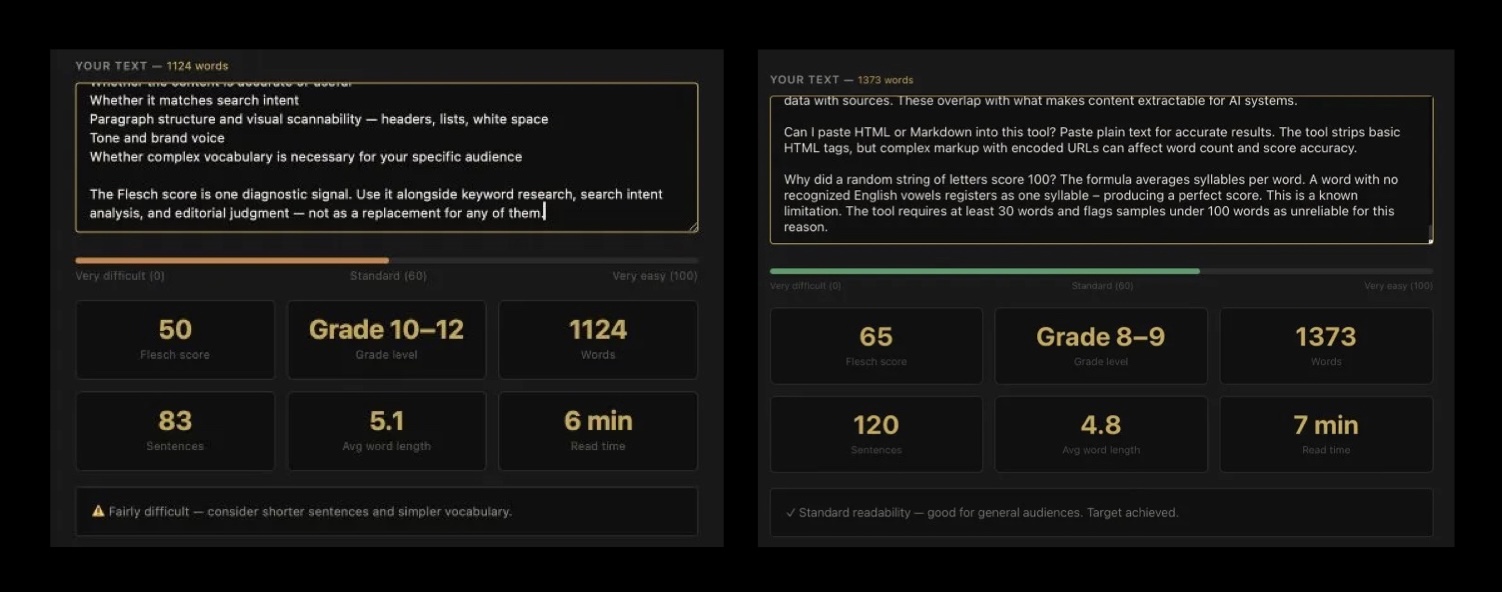
The article you're reading right now was tested in this tool twice – first in its original draft, then after rewriting for clarity and tone.
Before: Score 50, Grade 10–12, 1124 words, avg word length 5.1. Result: “Fairly difficult – consider shorter sentences and simpler vocabulary.”
After: Score 65, Grade 8–9, 1373 words, avg word length 4.8. Result: “Standard readability – good for general audiences.”
The content didn't change. The data, the arguments, the structure – all identical. What changed: passive constructions became active, academic qualifiers got cut, long sentences got split. The score jumped 15 points not because the writing became simpler – but because it became more direct.
That's the practical value of this tool. Not a target to hit, but a diagnostic that tells you whether your editing is moving in the right direction.
Who this tool is actually for
Writers editing their own drafts – paste before publishing. Below 50 on a general-audience piece means look at your longest sentences first.
SEO specialists auditing content – use it to benchmark readability across a site. Pages with very low scores on informational queries are worth reviewing.
GEO-focused content teams – use it as a proxy check for extractability. If the score is low, the writing is probably too dense for AI systems to pull cleanly.
Editors reviewing freelancer work – a quick score check surfaces obvious clarity issues without reading line by line.
What this tool doesn't do
It doesn't tell you which specific sentences are too long. It doesn't identify which words to replace. It doesn't analyze meaning, intent, or tone. It runs a mathematical formula and gives you a number.
That number is a starting point. What you do with it requires judgment that no formula can replace.
FAQ
Does a higher Flesch score help you rank higher on Google? No. Google confirmed it doesn't use readability scores as ranking signals. What matters is user behavior – engagement, dwell time, low bounce rate. Readable content tends to produce better engagement, but the score itself is invisible to Google's algorithm.
What score should I aim for? Depends on your audience. General content: 60+. Professional and B2B: 50–65. Technical documentation: 30–50 is acceptable. There's no universal target – the right score is the one that matches your readers' expectations.
Does readability affect AI citation in ChatGPT or Google AI Overviews? Not through the score. But the writing habits behind a good score do help – direct answers early, self-contained paragraphs, specific data with sources. These overlap with what makes content extractable for AI systems.
Can I paste HTML or Markdown into this tool? Paste plain text for accurate results. The tool strips basic HTML tags, but complex markup with encoded URLs can affect word count and score accuracy.
Why did a random string of letters score 100? The formula averages syllables per word. A word with no recognized English vowels registers as one syllable – producing a perfect score. This is a known limitation. The tool requires at least 30 words and flags samples under 100 words as unreliable for this reason.
Sources
- Flesch Reading Ease: Does It Matter for SEO? – Ahrefs (study of 15,000 keywords)
- How Content Readability Affects SEO and Rankings – Portent (756,297 pages studied)
- Flesch reading ease score in Yoast SEO – Yoast
- How To Test Readability – Screaming Frog
- Content Readability in SEO: 2026 Insights – Wellows
- Readability Levels That Win GEO/AEO Citations – Spotlight
- GEO Content Strategy 2026 – Incremys
- Flesch–Kincaid readability tests – Wikipedia
Tool built by Maiia Artemenko · serptop.pro