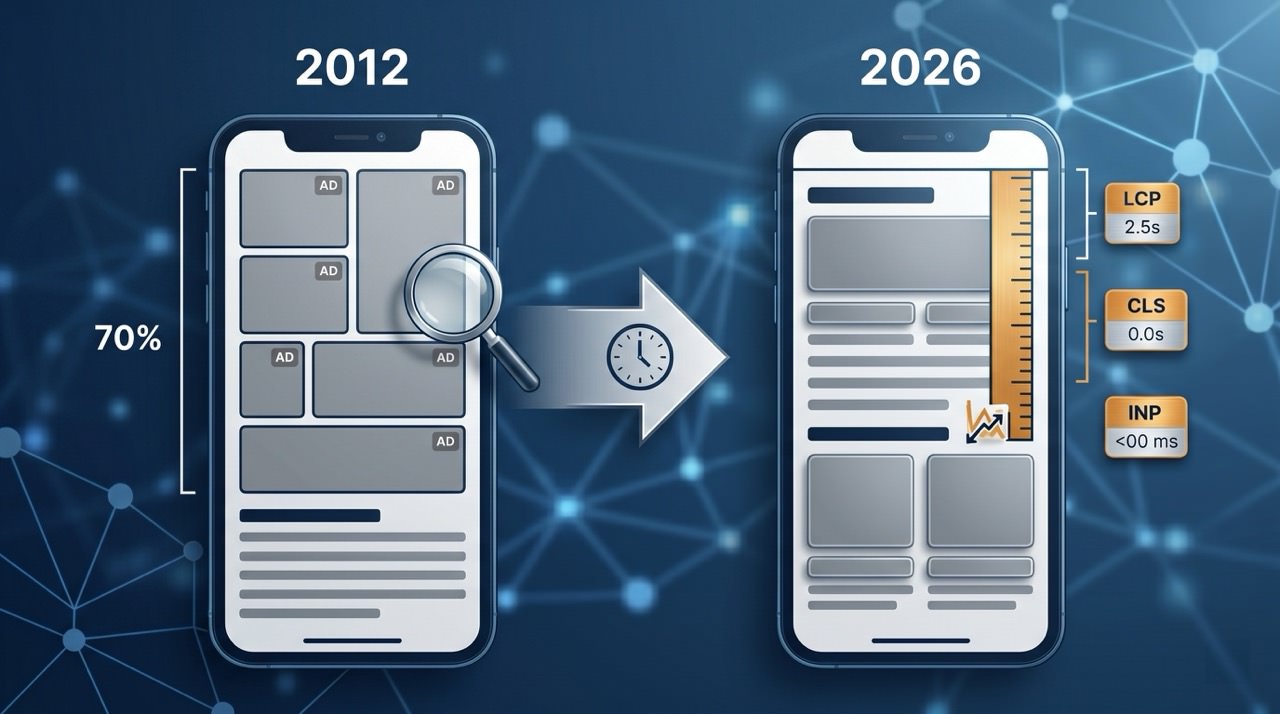
Google's Page Layout Algorithm – often called the “Top Heavy” update – launched on January 19, 2012. It demoted pages where ads dominated the area visible without scrolling, pushing actual content below the fold. It was refreshed in October 2012 and again in February 2014, and at launch it affected under 1 percent of global searches.
The important thing to understand in 2026 is that it no longer operates as a standalone penalty. The 2012 Top Heavy algorithm was absorbed into the Page Experience system Google rolled out in 2021, and the specific concern it addressed – too much above-the-fold advertising crowding out content – is now measured through Core Web Vitals, particularly Cumulative Layout Shift, plus the intrusive interstitials signal and behavioral metrics. After the December 2025 and February 2026 Core Updates, those signals carry more weight than the original Top Heavy algorithm ever did.
This guide explains what the Page Layout Algorithm actually was, what it became, and what the ad-heavy-header problem looks like in 2026 ranking terms. If you have a leaderboard ad pinned above your content, the relevant question is no longer “will Top Heavy penalise me” – it is “what is this doing to my CLS, my interstitial compliance, and my pogosticking rate.”
- What the Page Layout Algorithm originally did
- What it became: Page Experience and Core Web Vitals
- Why this matters more in 2026 than it did in 2012
- What a leaderboard ad above content actually does in 2026
- How to diagnose your own layout in 2026
- The honest framing for publishers
- What changed and what stayed the same
- FAQ
What the Page Layout Algorithm originally did
The 2012 algorithm was a direct response to a specific abuse. By 2012, many ad-funded sites had cluttered the top of the page with banners, leaderboards, and stacked ad units, forcing users to scroll past a wall of advertising to reach the content they came for.
Matt Cutts, then head of Google's webspam team, described the change as affecting less than 1 percent of searches but sending a clear signal: a page where the above-the-fold area is dominated by ads, with little or no visible content, provides a poor experience and should rank lower.
Three things defined the original algorithm:
- It evaluated the above-the-fold region – roughly the top 600 to 800 pixels depending on screen size – for the ratio of ads to content.
- It targeted pages where relevant content was persistently pushed down by large blocks of ads.
- It explicitly did not penalise a normal degree of advertising. Google was clear that ads above the fold are fine in moderation; the target was excess.
Google never published a specific ad-to-content ratio or a maximum number of ad units. There was no threshold to engineer against. The guidance was qualitative: don't let ads dominate the first screen.
What it became: Page Experience and Core Web Vitals
The Page Layout Algorithm was not retired with an announcement. It was folded into a broader, more measurable framework.
In June 2021, Google launched the Page Experience Update, which introduced Core Web Vitals as ranking signals. Page Experience built on the legacy of earlier user-focused initiatives – including the 2012 page layout algorithm – but replaced qualitative assessment with quantified metrics. By February 2022 it had fully rolled out to both mobile and desktop.
The concern the Top Heavy algorithm addressed – ads disrupting access to content – now lives in two specific Page Experience signals.
Cumulative Layout Shift (CLS). CLS measures unexpected movement of page elements as the page loads. An ad unit that loads after the text and pushes content down generates layout shift. A leaderboard that reserves no space and then appears, shoving everything below it, spikes CLS. This is the modern, measurable version of the Top Heavy problem: instead of a human-judged “too many ads up top,” Google now measures the actual disruption those ads cause to the loading experience. A poor CLS score is a direct ranking signal in 2026.
Intrusive interstitials. Separately from CLS, Google's intrusive interstitials signal – launched in 2017 and still active in 2026 – targets pop-ups and layouts that block content. Critically, this signal explicitly covers “a layout where the above-the-fold portion of the page appears similar to a standalone interstitial, but the original content has been inlined underneath the fold.” That is the Top Heavy problem described almost word for word, now enforced through the interstitials signal rather than a separate page-layout algorithm.
The practical effect: the 2012 question “do I have too many ads above the fold” splits into two measurable questions in 2026. Does my above-the-fold advertising hurt my CLS? And does my header layout resemble an interstitial that buries content?
Why this matters more in 2026 than it did in 2012
The original Top Heavy algorithm affected under 1 percent of searches and was, by Google's own framing, a minor signal. The signals that replaced it are not minor, and two 2025-2026 Core Updates made them heavier.
The December 2025 Core Update, which rolled out from December 11 to 29, was one of the most significant in recent years. Analysis of 100,000 keywords across 20 industries found that roughly 15 percent of pages previously ranking in the top 10 disappeared from the top 100 entirely. The February 2026 Core Update, rolling out February 1 to 14, tightened requirements further. Both updates weighted Page Experience more heavily than before. Slow pages, high CLS values, and intrusive interstitials correlated consistently with ranking losses.
What was once treated as a soft ranking factor has gained measurable weight. A site with a heavy ad leaderboard above the fold in 2026 faces three compounding problems the 2012 site did not:
- Direct CLS penalty if the ad causes layout shift, now a confirmed ranking signal.
- Interstitial-signal risk if the header layout pushes content below the fold in a way that resembles an interstitial.
- Behavioral signal damage – the December 2025 update increased the weight of pogosticking and dwell time. A user who lands on an ad-heavy page, can't immediately see the content, and bounces back to search sends a negative behavioral signal that compounds the technical penalties.
The third factor is the one most site owners underestimate. Even if your ad-heavy header passes CLS and doesn't trigger the interstitial signal, a layout that makes users work to find content increases your bounce-back rate. In 2026, with behavioral signals weighted more heavily, that bounce-back is itself a ranking problem.
What a leaderboard ad above content actually does in 2026
A pinned leaderboard ad above the article content – the classic publisher layout – is worth examining specifically, because it is the exact pattern the Top Heavy algorithm was built for.
In 2026 terms, here is what that leaderboard does:
If it loads late and shifts content: it spikes CLS. The fix is reserving the ad's space in the layout so the slot exists before the ad loads – a fixed-height container that doesn't collapse or expand. This is a standard CLS mitigation and it directly addresses the leaderboard problem.
If it occupies too much of the mobile viewport: it risks the interstitial signal. The consensus from real-world audits is that elements occupying more than 30 percent of the mobile viewport above the fold enter the high-risk zone, and 50 percent or more almost always triggers the penalty. A full-width leaderboard on mobile that pushes the headline and first paragraph below the fold is squarely in this territory.
If it pushes all content below the fold: it resembles the interstitial-style layout Google explicitly names. Even without a modal or pop-up, a “fat header” design that prioritises promotional space over content access falls under the interstitial signal.
The fix is not “remove all ads.” Google has been consistent since 2012 that a normal degree of above-the-fold advertising is acceptable. The fix is ensuring the ad does not shift layout (reserve its space), does not dominate the mobile viewport (keep it under 30 percent above the fold), and does not push the content's opening below the fold (let the headline and first lines of content be visible without scrolling).
How to diagnose your own layout in 2026
The diagnostic process has changed since 2012. There is no “Top Heavy penalty” to check for in Search Console. Instead, check the signals that replaced it.
Check Core Web Vitals in Search Console. The Core Web Vitals report shows your CLS scores grouped by URL pattern. Pages in the “poor” or “needs improvement” CLS band are where ad-driven layout shift is most likely hurting you. This is the single most direct check.
Run PageSpeed Insights on a representative page. It reports CLS for both lab and field data, and flags the specific elements causing layout shift. If an ad slot is the culprit, it appears in the diagnostics.
Test the mobile viewport coverage. Load a representative page on an actual mobile device and observe how much of the first screen is ad versus content. If the headline and opening content are not visible without scrolling, you have an interstitial-signal risk regardless of CLS.
Check behavioral signals indirectly. In analytics, look at bounce rate and time-on-page for pages with heavy above-the-fold advertising versus your cleaner pages. A consistent gap suggests the layout is costing you engagement, which after December 2025 is itself a ranking factor.
Cross-reference with Core Update timing. If you saw ranking drops aligned with the December 2025 or February 2026 Core Updates, and the affected pages have heavy above-the-fold advertising, the layout is a likely contributor. The Google algorithm update history tracks the timeline of these updates for cross-referencing.
The honest framing for publishers
There is a real tension here, and pretending otherwise is dishonest. Ad-funded sites need advertising revenue, and above-the-fold ad placements perform better than below-the-fold ones. The leaderboard is above the content because that position earns more.
Google's position – which is worth stating plainly given that Google earns most of its own revenue from advertising – is not “no ads.” It is that the first screen should give the user access to the content they came for, with advertising present but not dominant. The 2012 algorithm said this qualitatively. The 2026 signals say it quantitatively through CLS, interstitial coverage, and behavioral metrics.
For a publisher, the practical resolution is layout engineering rather than ad removal:
- Reserve ad slot space to eliminate layout shift (protects CLS).
- Size above-the-fold ads to stay under 30 percent of the mobile viewport (protects against the interstitial signal).
- Ensure the content headline and opening lines are visible on the first screen (protects against both the interstitial signal and bounce-back behavior).
- Place the heaviest ad units below the first screen, where they still earn but don't trigger the layout signals.
This keeps the revenue-driving placements while staying clear of the signals that replaced Top Heavy. It is more work than pinning a leaderboard to the top, but in 2026 the pinned leaderboard is a measurable ranking liability, not just a soft one.
What changed and what stayed the same
The continuity from 2012 to 2026 is the underlying principle: users should reach content quickly, and layouts that bury content behind advertising rank worse. That has not changed in fourteen years.
What changed is enforcement. In 2012, a single algorithm made a qualitative judgment about ad density above the fold, affecting under 1 percent of searches. In 2026, the same concern is enforced through three measurable, heavily-weighted signals: CLS as a Core Web Vital, the intrusive interstitials signal, and behavioral metrics that the December 2025 Core Update made more important. The judgment is no longer “this looks too ad-heavy” – it is “this CLS score is poor, this layout covers too much viewport, and users bounce from this page.”
For SEO work, the practical implication is that the productive targets are CLS, mobile viewport coverage, and the engagement signals that follow from a clean above-the-fold experience – rather than a discrete “Top Heavy” factor, which no longer exists as such. The AI Overview guide covers how the broader 2026 ranking landscape has shifted, and the layout signals discussed here are one input into that larger picture.
FAQ
Does the Google Page Layout Algorithm still exist in 2026?
Not as a standalone algorithm. The 2012 Page Layout (Top Heavy) algorithm was absorbed into the Page Experience system launched in 2021. The concern it addressed – ads crowding out above-the-fold content – is now measured through Core Web Vitals (especially CLS), the intrusive interstitials signal, and behavioral metrics, which carry more weight than the original algorithm did.
What was the Top Heavy update?
The Top Heavy update, officially the Page Layout Algorithm, launched January 19, 2012. It demoted pages where the above-the-fold area was dominated by advertising, pushing actual content below the fold. It was refreshed in October 2012 and February 2014 and affected under 1 percent of global searches at launch.
How many ads above the fold is too many for Google?
Google has never published a specific number or ad-to-content ratio. The 2012 guidance was qualitative: a normal degree of above-the-fold advertising is fine, but ads should not dominate the first screen. In 2026 terms, the practical limits are keeping above-the-fold ads under roughly 30 percent of the mobile viewport and ensuring they don't cause layout shift.
What is Cumulative Layout Shift and how does it relate to ads?
CLS is a Core Web Vital that measures unexpected movement of page elements as the page loads. An ad unit that loads late and pushes content down generates layout shift and a poor CLS score, which is a direct ranking signal in 2026. Reserving the ad's space in the layout before it loads prevents the shift.
Will a leaderboard ad above my content hurt my rankings?
It can, through three mechanisms: a poor CLS score if it causes layout shift, the intrusive interstitials signal if it covers too much of the mobile viewport or pushes content below the fold, and damaged behavioral signals if users bounce because they can't see the content. The fix is reserving the ad's space, keeping it under 30 percent of the mobile viewport, and ensuring content is visible on the first screen.
What is the intrusive interstitials penalty?
Launched in 2017 and still active in 2026, it targets pop-ups and layouts that block content on mobile. It explicitly covers layouts where the above-the-fold area resembles a standalone interstitial with content pushed below the fold – the same problem the Top Heavy algorithm addressed. Elements covering more than 30 percent of the mobile viewport are high-risk; 50 percent or more almost always triggers it.
Did the December 2025 Core Update affect ad-heavy pages?
Yes. Analysis of 100,000 keywords found roughly 15 percent of pages previously in the top 10 dropped out of the top 100 after the December 2025 Core Update. The update weighted Page Experience more heavily, and slow pages, high CLS, and intrusive interstitials correlated with ranking losses. The February 2026 Core Update tightened this further.
How do I check if my ad layout is hurting my SEO?
Check the Core Web Vitals report in Search Console for poor CLS scores, run PageSpeed Insights on a representative page to identify layout-shift culprits, test mobile viewport coverage on an actual device, and compare bounce rate and time-on-page for ad-heavy pages versus cleaner ones. Cross-reference any ranking drops with the December 2025 and February 2026 Core Update timing.
Does Google penalise all above-the-fold ads?
No. Google has been consistent since 2012 that a normal degree of above-the-fold advertising is acceptable and that these placements help publishers monetise. The target is excess – ads that dominate the first screen, cause layout shift, or push content below the fold. Moderate, well-implemented above-the-fold ads are fine.
What's the difference between the Page Layout Algorithm and the Page Experience Update?
The Page Layout Algorithm (2012) was a single signal making a qualitative judgment about above-the-fold ad density. The Page Experience Update (2021) is a broader framework that introduced Core Web Vitals as measurable ranking signals. The page layout concern was absorbed into Page Experience, where it is now enforced through quantified metrics rather than a discrete algorithm.
How do I fix a high CLS caused by ads?
Reserve the ad slot's space in your layout using a fixed-height container so the slot exists before the ad loads. This prevents the content from shifting when the ad appears. Avoid ad units that expand or collapse after loading, and ensure any dynamically inserted ads have pre-allocated space.
Is the above-the-fold concept still relevant with AI Overview?
Yes. While AI Overview and AI Mode have changed how results are presented, the page experience signals still apply to the pages Google ranks and cites. A page with poor CLS or an interstitial-style layout is a weaker candidate for both traditional ranking and AI citation, since the underlying quality signals feed both systems.
The Page Layout Algorithm is a useful case study in how Google's ranking signals evolve. The 2012 version made a rough qualitative judgment about ad-heavy headers. Fourteen years later, the same principle is enforced through precise, heavily-weighted metrics – CLS, interstitial coverage, and behavioral signals – that the December 2025 and February 2026 Core Updates made more consequential than the original algorithm ever was. The practical takeaway: the targets that move rankings in 2026 are CLS, mobile viewport coverage, and the engagement signals that a clean above-the-fold experience produces.