On May 18, 2026, Google announced that AI Mode crossed one billion monthly users in twelve months. The same day, the company introduced information agents – background processes that run inside Google Search 24/7, monitoring topics on behalf of the user and pushing notifications when something changes. The search box itself was redesigned for the first time in 27 years.
Most of the coverage is treating these as separate features. They are not. Together, they signal a structural shift in what Google Search is. For the last two decades, Search has been a transactional product: type a query, get a list of links, end of interaction. Starting this summer, Search becomes stateful – a service that remembers what you asked, keeps watching, and surfaces updates without being asked again.
This is the most important Google I/O for SEO since the AI Overview launch. Here is what changed, why it matters, and what to do about it before the rest of the industry catches up.
What Google actually announced
Three changes form the core. Everything else flows from them.
AI Mode hit one billion monthly users. Twelve months from launch to a billion users is faster than YouTube, faster than ChatGPT, faster than any product in Google's history. AI Overviews now serves 2.5 billion monthly users. The combined surface is no longer experimental – it is the dominant interface for Search.
Information agents launch this summer. Persistent, customisable, always-on background processes inside AI Mode that monitor topics and push synthesised updates via notifications. Google explicitly framed this as the next evolution of Google Alerts – the first major upgrade to that product since 2003. Initial rollout: AI Pro and AI Ultra subscribers in the United States, then wider markets.
The search box was redesigned. For the first time in 27 years, the input field itself changed. It now expands for longer conversational queries, has AI-powered intent suggestions that go beyond autocomplete, and serves as the entry point for stateful agentic tasks. This is the surface most users have interacted with billions of times. Google rebuilt it.
A fourth change is worth noting because of what it implies for future rollouts: AI Mode default model is now Gemini 3.5 Flash, with Gemini 3.5 Pro arriving in June. The agentic capabilities of the new search experience are not a separate research preview – they are powered by the same model family running everywhere else in the Google stack. The infrastructure is unified, which means rollouts will be faster than the 2024-2025 AI Overview timeline.
The shift that matters: search becomes stateful
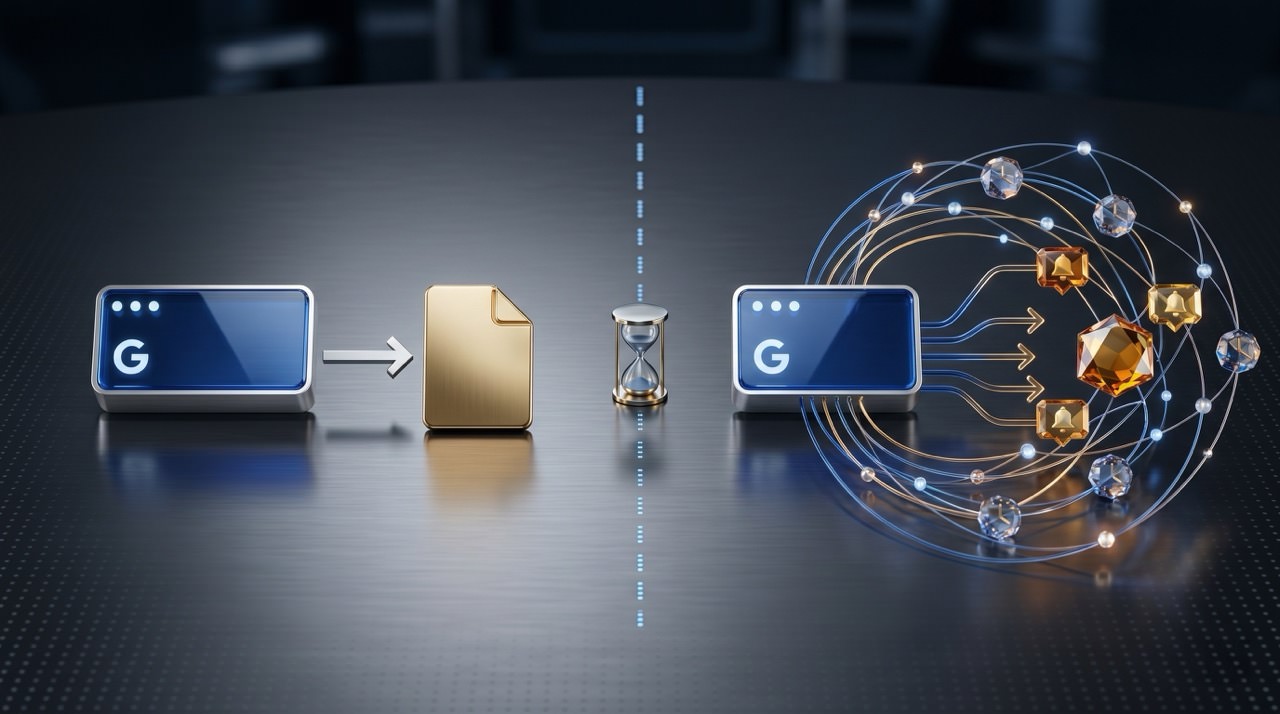
Two decades of SEO has been built around a specific assumption. Each query is independent. A user types something, Google returns ranked results, the interaction ends. Optimisation has been about being one of those returned results.
That assumption is now wrong.
Information agents persist after the first query. A user who asks Google to track biotech companies with positive cash flow and low debt does not just get a one-time answer. The agent keeps monitoring – every day, every hour, with no further user input – and surfaces updates when something changes. The user is no longer querying. They are subscribing.
This sounds like a feature. It is actually a redefinition of what Search is. For a stateful agent monitoring a topic, the question changes from “what ranks for this query right now” to “what gets included in the agent's ongoing synthesis, and how often.”
The mechanics imply different optimisation:
- The agent samples sources over time, not at one moment. A page that ranks for a week and then gets buried may still be included in an agent's update if it appears during the agent's monitoring window. Conversely, a page that ranks consistently for a year may be excluded if the agent's window prioritises freshness.
- The agent compares state over time. Information agents do not just retrieve – they detect changes. A site that updates content regularly, or that publishes new material in response to news events, becomes more valuable to an agent than a static page with the same baseline content quality.
- The agent synthesises across sources. As with AI Overview, the citation pattern is dispersed. But unlike AI Overview, the synthesis is repeated. A page cited once in an agent's daily update gets compounded exposure across the user base subscribed to that topic.
The unit of value shifts from “the page that ranks today” to “the page that gets included in the rolling synthesis.”
Why one billion AI Mode users in twelve months matters
The growth number matters because it determines whether SEO teams should treat AI Mode as a real channel or a research preview.
For comparison: ChatGPT took roughly two months to hit a hundred million monthly active users, and reached one billion weekly users in about three years. Instagram took two and a half years to reach one billion monthly users. AI Mode reached one billion monthly active users in twelve months from launch.
The implication is that the audience is already there. The question for the next six months is not whether AI Mode becomes mainstream – it already is. The question is whether your content is structured to be cited by AI Mode rather than just AI Overview.
The two surfaces share infrastructure. Both run on Gemini 3 Flash. Both use query fan-out. Both cite three to five sources per response. But AI Mode is conversational and stateful. A user asks a follow-up. The follow-up does not start a new ranking cycle – it extends the existing conversation, drawing on the same source pool, possibly retrieving additional pages for the new sub-query but anchored to the previous context.
For SEO, this means a page that is referenced in the first AI Mode response will tend to be referenced in subsequent follow-ups within the same conversation. The first citation compounds. The page that earns the initial reference earns disproportionate downstream attention.
This is opposite to the AI Overview pattern, where each query was independent. AI Mode rewards being cited early and stickily.
What changes for SEO in the next six months
Five practical shifts that follow from the announcements.
Citation eligibility now matters across two different time horizons
For AI Overview, citation was a per-query event. For information agents, citation becomes a recurring event over time. A page that appears in an agent's weekly update for six months earns dozens of impressions to the same user.
The implication: content freshness and update cadence become measurable inputs to citation share. Pages that change in response to news events, that publish updated data quarterly, that timestamp revisions visibly – these signals matter more in a stateful surface than they did in a transactional one.
The teams that have been treating “publish once and forget” as adequate are about to lose ground to teams that have publishing cadence built into their content systems.
The intelligent search box changes query volume distribution
When the search box accepts and encourages longer conversational queries, the head-tail distribution of queries shifts. Three-word queries become five-word queries. Five-word queries become full sentences. The intent expressed in a query gets more specific, which means the long tail expands rapidly.
For SEO planning, this means traditional keyword volume tools systematically underestimate the queries that matter. A keyword tool showing “ai overview citation pattern” at fifty searches a month will not capture the same intent now expressed as “how does Google AI overview decide which sources to cite in 2026”. The latter has lower volume in any tool today, but is the actual query shape that drives traffic in the new search box.
The teams that pivot keyword research from head-term tracking to intent-cluster mapping will read the new traffic correctly. The teams that stay on head terms will see their reports increasingly diverge from reality.
Agentic booking and agentic shopping remove an entire SEO category
Search now performs the booking and the purchase itself in select categories. Restaurant reservations, local services, home repair, beauty, pet care – Search will call businesses on the user's behalf. For shopping, the Universal Cart works in the background to validate compatibility, suggest alternatives, and complete purchases through the new Agent Payments Protocol.
For the affected categories – local services especially – the traditional path of “rank the page, get the click, convert on the page” is being shortcircuited. The user never reaches the page. The booking happens inside Search.
The optimisation target shifts to being one of the providers Search calls. This is much closer to a product feed problem than a content SEO problem. Local SEO teams need to start treating booking metadata, real-time availability feeds, and direct partnerships with reservation platforms as ranking signals in this category.
Premium-first rollout signals a new monetisation layer
Information agents launch to AI Pro and AI Ultra subscribers first. The two tiers cost $20 and $250 per month respectively. This is unusual for Google – historically, new search features rolled out broadly because the ad revenue model depended on scale.
The fact that the most agentic Search features are gated behind subscription means Google is testing whether the high-end Search user will pay directly. This has two implications for SEO.
First, the users with information agents are by definition higher-income, more technical, more engaged. If your audience overlaps with this demographic – senior professionals, finance, B2B – the early users of stateful search are exactly the people you want to reach. Optimisation for information agents in 2026 reaches the highest-value users earliest.
Second, Google is implicitly admitting that agentic search and ad-supported search may be different products. The free tier may continue to see lighter agentic capabilities while premium subscribers get the full experience. This bifurcation, if it persists, changes how to think about user intent: the user typing a query in the free tier and the user with three information agents tracking topics may have fundamentally different relationships with Search.
The conversational follow-up changes what “ranking” means
AI Overview supports ask-follow-up questions in AI Mode as part of the same product wave. Users no longer end the interaction after the initial answer. They continue, asking clarifications, expansions, comparisons.
The page that gets cited in the initial AI Overview answer enters the conversation. The page that does not get cited initially is unlikely to be retrieved for the follow-up. This creates a path-dependence in Search results that did not exist before: early citation increases the probability of repeated citation through the conversation.
The practical implication for content design: pages that anticipate the follow-up questions a topic will generate – not just the head query – have a structural advantage. Writing a page that answers one question is no longer enough. Writing a page that anticipates the cluster of follow-up questions a user will ask after reading the first answer is the new standard.
What to do this quarter
If you are reading this in May or June of 2026, the timing matters. Information agents are not yet generally available. The intelligent search box is rolling out. Most SEO teams are reading the same recap coverage and will respond in the same way – wait, watch, react when the data comes in.
The faster move is to build for the new surface now, before competitors do. Three concrete projects for the next ninety days.
Audit your top fifty pages for fan-out coverage. For each page, identify the head query it targets, then list the eight to fifteen sub-questions a user might ask as follow-ups in AI Mode. Score each page on how completely it answers those follow-ups. Pages that score weak on follow-up coverage are pages that will lose AI Mode citation share. Rewrite them to anticipate the conversation, not just the query.
Build a content update cadence into your editorial system. Whatever your current refresh schedule is, double it on your most important pages. The page that gets updated monthly will be preferred by information agents over the page that gets updated yearly, all else equal. This is a low-cost intervention with compounding returns over the next six months.
Map your category for agentic shortcuts. If you operate in a vertical Google has announced agentic capabilities for – restaurant reservations, local services, home repair, beauty, pet care, shopping – your traffic from Search will be partially absorbed by Search itself. Identify which queries in your tracking are now agentic-eligible. Plan for those queries to lose click-through to traditional pages. The remaining traffic is what you will be competing for.
These are not speculative bets. They are specific responses to specific announcements that Google has already shipped or is shipping in the next ninety days.
Where this is going by I/O 2027
A prediction worth committing to writing.
By Google I/O 2027, information agents will be available to all Search users, not just AI Pro and Ultra subscribers. The rollout pattern across all major Google features – AI Overview, AI Mode, agentic booking – has followed the same arc: premium subscribers first, free tier within twelve months. There is no reason to expect information agents to follow a different path.
What this means for SEO is that the optimisation work for stateful search has a one-year window. Teams that build content systems aligned with the new surface in 2026 will compound their lead through 2027. Teams that wait for the feature to become mainstream before adjusting will be optimising for an interface most users have already moved past.
The pattern is the same one that played out with AI Overview. The teams that started writing for citation eligibility in 2024 had a year of compounding advantage over the teams that started in 2025. The same dynamic now applies to stateful search, but with a faster timeline because the underlying infrastructure (Gemini 3.5 Flash, unified across all products) is already shipped.
The shift from transactional search to stateful search is the biggest structural change to SEO since AI Overview. The window to be early on it is open now and probably closes by mid-2027.
FAQ
What is information agents in Google Search?
Information agents are persistent background processes inside Google AI Mode that monitor topics on behalf of users 24/7, surfacing synthesised updates via push notifications. They were announced at Google I/O on May 18, 2026, and roll out this summer to AI Pro and AI Ultra subscribers in the United States. Google describes them as the next evolution of Google Alerts, which launched in 2003.
How many users does AI Mode have in 2026?
AI Mode crossed one billion monthly active users in twelve months from launch, announced at Google I/O 2026. AI Overviews serves 2.5 billion monthly users. The combined AI search surface is now the dominant search experience for Google users globally.
What is the new Google search box at I/O 2026?
Google redesigned the search box for the first time in 27 years. The new search box expands to accommodate longer conversational queries, offers AI-powered intent suggestions beyond traditional autocomplete, and serves as the entry point for stateful agentic tasks like information agents and agentic booking. The redesign is rolling out globally in all countries and languages where AI Mode is available.
What model powers Google AI Mode in 2026?
AI Mode now runs on Gemini 3.5 Flash by default, announced at I/O 2026. Gemini 3.5 Pro will follow in June. The same model family powers AI Overview, the new search agents, and Google's agentic coding tools like Antigravity.
How does stateful search change SEO?
Stateful search shifts optimisation from per-query ranking to ongoing citation share. Pages cited by information agents are referenced repeatedly to the same user over time. Freshness and update cadence become measurable ranking signals. Content that anticipates follow-up questions in conversational AI Mode gains structural advantage over content that only addresses head terms.
Will information agents kill traditional SEO?
No, but they significantly reshape it. Traditional ranking still determines candidate eligibility for citation in both AI Mode and information agents. The change is in what happens after candidate eligibility – stateful agents create compounding citation effects that did not exist in transactional search. Teams that adapt their content to the new patterns will outperform teams that don't.
How much does Google AI Ultra cost?
Google AI Ultra costs $250 per month. AI Pro costs $20 per month. Information agents launch first to subscribers of both tiers in the United States this summer, before broader availability. The premium-first rollout suggests Google is testing direct subscription revenue for its most agentic Search features.
What is the agentic booking in Google Search?
Agentic booking lets Search complete reservations and purchases on the user's behalf in select categories: restaurants, local services, home repair, beauty, pet care, and shopping. For some categories, Google will call businesses directly on behalf of users. Launching to all US users this summer.
How do query fan-out and stateful search interact?
Query fan-out splits a user query into multiple sub-questions retrieved independently. Stateful search extends this across time: a sub-question retrieved in the initial query becomes part of the persistent context for follow-up conversation. Pages cited early in the fan-out gain compounding exposure across the conversation, making early citation more valuable than late citation.
Should I optimise for AI Mode or AI Overview first?
Both share underlying infrastructure (Gemini 3.5 Flash, same citation logic) but differ in stateful behaviour. Optimisation that works for AI Overview – direct-answer structure, extractable claims, citation-worthy formats – also works for AI Mode. The additional work for AI Mode is anticipating follow-up questions and maintaining update cadence on pages that target evergreen topics.
What categories will be most affected by agentic Search?
The first agentic-eligible categories announced at I/O 2026 are restaurant reservations, local services (home repair, beauty, pet care), event ticketing, and shopping. SEO teams in these verticals should expect significant click-through loss to in-Search task completion within twelve months. Optimisation for these categories shifts from page ranking to being one of the providers Search calls.
Will information agents be available outside the United States?
Initial rollout is US-only this summer, for AI Pro and AI Ultra subscribers. Google announced wider market expansion but did not provide a specific timeline. Based on the rollout patterns of AI Overview and AI Mode, broader availability is likely within twelve to eighteen months.
Is the Google search box redesign live now?
Yes. The redesigned search box is rolling out globally as of I/O 2026 in all countries and languages where AI Mode is currently available. Information agents and full agentic booking are launching this summer in stages.
What is Personal Intelligence in AI Mode?
Personal Intelligence is a Google AI Mode feature that integrates personal context from Gmail, Calendar, and Photos to provide personalised search results and synthesis. As of I/O 2026, it's expanding to nearly 200 countries and territories across 98 languages, no subscription required.
How quickly will SEO need to adapt to stateful search?
The window for first-mover advantage is approximately six to twelve months, mirroring the AI Overview pattern from 2024. Teams that adjust content strategy in mid-2026 will have a year of compounding citation advantage by mid-2027 when information agents reach the free tier of Search users globally.
The headline coverage of Google I/O 2026 has focused on individual features. The structural story is bigger. Search is no longer a transaction – it's a subscription to an answer that updates. The teams that internalise that shift this quarter will have a year of advantage over the teams that read the recap, move on, and react when traffic patterns force them to.