If you searched “DuckDuckGo proxy” and got back ten articles that all say slightly different things, that is not your fault. The phrase covers two completely different products, and most articles on the first page quietly merge them.
So before anything else, let me sort the two products apart. Then we go deep on each.
- What “DuckDuckGo proxy” actually means
- How DuckDuckGo's Anonymous View works
- Anonymous View vs VPN vs Tor vs Firefox
- Is DuckDuckGo legitimate? Trust signals and real concerns
- Does DuckDuckGo block ads?
- Speed and reliability in everyday use
- When Anonymous View is the right choice
- When you need a VPN or Tor instead
- DuckDuckGo alternatives and competitors
- Using a third-party proxy with DuckDuckGo (the other meaning)
- The DuckDuckGo Tor onion service – the forgotten third option
- Where DuckDuckGo's results actually come from
- What changed in 2026
- FAQ
What “DuckDuckGo proxy” actually means
There are two distinct products hiding behind the same phrase.
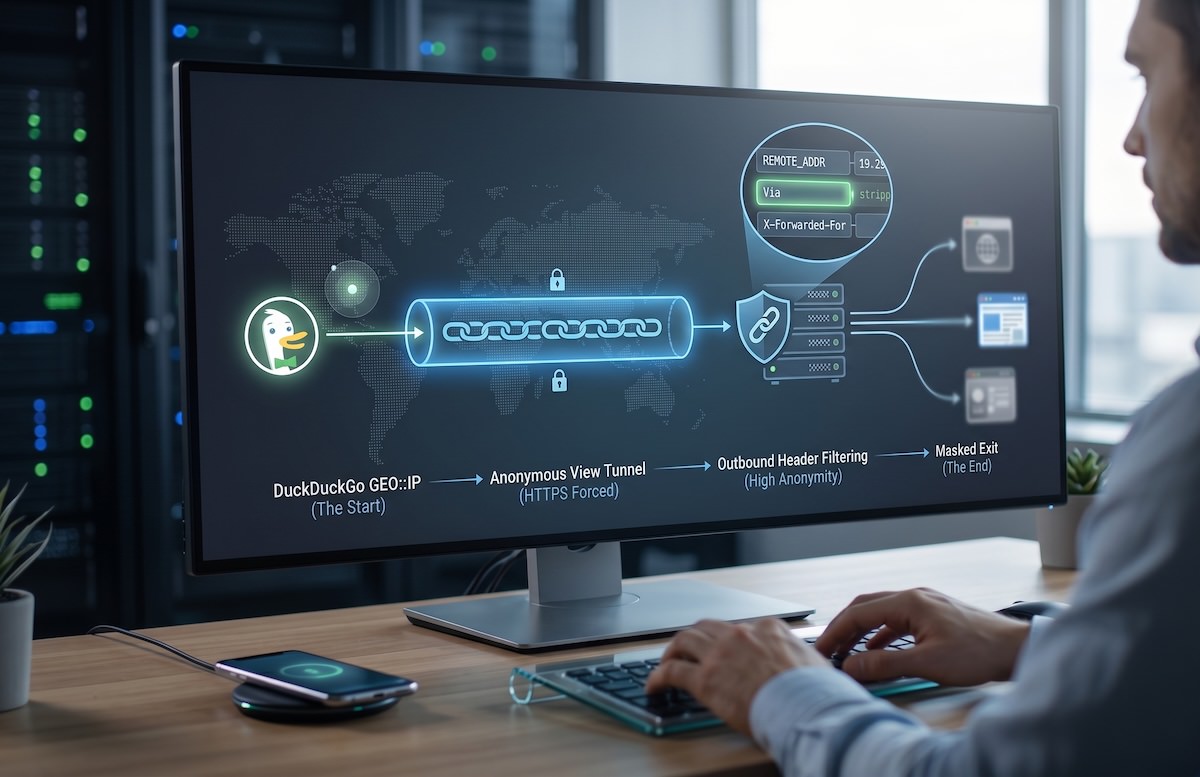
Meaning one – DuckDuckGo Anonymous View. A feature built into DuckDuckGo (the privacy search engine launched in 2008 by Gabriel Weinberg). When you search and see a result you want to open, DDG offers a small “Anonymous View” link next to it. Click that and DuckDuckGo fetches the page on your behalf and hands the content back to you. The destination site never sees your IP.
Meaning two – a third-party proxy used while interacting with DuckDuckGo. The kind of proxy you buy or rent (residential, datacenter, mobile, SOCKS5) and configure in your OS or browser. It hides your real IP from DuckDuckGo itself and is the only path if you are scraping search results, automating queries through the DuckDuckGo API, or routing through a specific country.
These solve almost opposite problems. The first protects you from the destination site; the second protects you from DuckDuckGo. Once the split is clear, the rest is straightforward.
How DuckDuckGo's Anonymous View works
Anonymous View is the more interesting of the two – it is free, built in, and widely misunderstood.
The request flow, step by step
- You search on duckduckgo.com.
- You click the “Anonymous View” link next to a result instead of the regular link.
- Your browser sends a request to a DuckDuckGo proxy endpoint that wraps the destination URL.
- DDG's server fetches the destination page on its own infrastructure.
- The destination site sees DuckDuckGo's IP and DuckDuckGo's User-Agent, not yours.
- DDG returns the rendered content to your browser, with most scripts and trackers stripped.
That is the whole mechanism. It is a server-side content proxy, not a tunnel. Your traffic to DuckDuckGo uses HTTPS. The fetch from DuckDuckGo to the destination is also HTTPS where available. But there is no end-to-end encryption between you and the destination – DuckDuckGo sits in the middle as a content fetcher, and that role has consequences.
What Anonymous View hides – and what it does not
Hides from the destination site:
- Your real IP address
- Your browser fingerprint (User-Agent, headers, screen size, fonts)
- Most client-side trackers, because many of them never load
- Cookies you previously set on the destination – the request comes from DuckDuckGo, not you
Does not hide:
- Your activity from DuckDuckGo itself. DDG processes the click in real time. The company's privacy policy says it does not store search or click history tied to individual users, but the click does pass through its servers
- Your activity from your ISP or network admin – they still see you connected to DuckDuckGo
- Your real IP on any site you visit outside that one clicked search result
The last point is the one most people miss. Anonymous View is single-use, per click. The moment you interact with anything inside the proxied page – a link, a form, an image – you are back to your real IP. There is no session, no tunnel, no persistent anonymity. Treat it as a one-shot lens, not a privacy mode.
A quick note on a related feature: DuckDuckGo Images opens image results inside the same proxied view, so reverse image curiosity does not leak to the image host. Same mechanism, different content type.
Anonymous View vs VPN vs Tor vs Firefox
Marketing copy flattens these tools into one category. They are not in the same category. Each one solves a specific problem.
| DDG Anonymous View | Consumer VPN | Tor Browser | Firefox alone | |
|---|---|---|---|---|
| Scope | One clicked search result | All device traffic | All Tor Browser traffic | Browser-level only |
| Hides IP from destination | Yes | Yes | Yes (exit node IP) | No |
| Hides IP from DuckDuckGo | No | Yes | Yes | No |
| Encrypts full connection | No (HTTPS only) | Yes (VPN tunnel) | Yes (3 layers) | No |
| Persistent session | No | Yes | Yes (in same circuit) | Yes |
| Speed cost | Low to medium | Low to medium | High | None |
| Cost | Free | $3–12 / month | Free | Free |
| Right for | One-click anonymous look | Day-to-day privacy | High-anonymity needs | Convenience only |
A few notes the table flattens.
Firefox vs DuckDuckGo. People search for this because they assume Firefox provides privacy comparable to the DuckDuckGo browser. It does not, out of the box. Default Firefox blocks third-party cookies and some trackers, but it does not strip tracking scripts before they load. The DuckDuckGo browser blocks third-party trackers before they load – which is a meaningful difference for browser fingerprinting. If you stay on Firefox, install uBlock Origin and switch to Strict tracking protection; that closes most of the gap.
Is DuckDuckGo as good as Google for results? For mainstream queries – yes, mostly. DuckDuckGo's traditional web results come largely from Bing (more on that below), and Bing's index is wide enough that you rarely notice. Where Google still wins: long-tail technical queries, recent niche posts, and small forum threads. That is index size, not privacy.
Is DuckDuckGo legitimate? Trust signals and real concerns
This question comes up often enough – “is DuckDuckGo legitimate”, “duckduckgo legit”, “how secure is duck duck go” – that it deserves an honest answer.
DuckDuckGo is a real company headquartered in Pennsylvania, run by Gabriel Weinberg since 2008, with a privacy policy that has been independently scrutinised more than once. The search engine itself does not log queries against user identities, does not serve personalised ads, and does not build behavioural profiles. By the standards of mainstream search engines in 2026, it is among the more legitimate privacy options.
The real concerns sit in two places.
The first is the 2022 Microsoft trackers episode. In May 2022, privacy researcher Zach Edwards documented that DDG's mobile browser was allowing some Microsoft-owned tracking scripts (LinkedIn, Bing) to load on third-party sites, due to a clause in DDG's search syndication agreement with Microsoft. WIRED and several other outlets covered it. In August 2022, DuckDuckGo amended terms with Microsoft and removed the carve-out. The episode is the strongest argument for not treating any single tool as a complete privacy answer.
The second is the dependency on Bing. DuckDuckGo's traditional web results come mostly from Microsoft's search index, with DDG's own crawler (DuckDuckBot) and vertical partners layered on top. This is fine for privacy in the user-facing sense – DDG strips identifiers before forwarding – but it means DDG inherits whatever ranking decisions Bing makes. If you are looking for source independence, DuckDuckGo is not it. Brave Search and Mojeek run their own indexes.
Use DuckDuckGo where it fits, do not expect more from it than the architecture provides.
Does DuckDuckGo block ads?
Yes and no, depending on what you mean.
The DuckDuckGo search results page does show ads. These are Bing-syndicated ads served based on the search query itself, not on a profile of you. DDG does not personalise them and does not track click behaviour the way Google or standalone Bing does. If you are fine with non-personalised ads, this is the right level of friction.
The DuckDuckGo browser is a separate question. It blocks third-party trackers and many in-page ads on third-party sites you visit through it. It does not block search ads on duckduckgo.com itself, because those are how DDG funds operations. If you want a fully ad-free experience inside the DDG browser, install uBlock Origin or pair the browser with a content blocker.
The browser is also where Duck Player lives – DDG's YouTube wrapper that strips tracking and most ads from videos opened through it.
Speed and reliability in everyday use
Anonymous View routes your request through DuckDuckGo's infrastructure, so latency depends on two things: how close their proxy server is to you, and how complex the destination page is.
In practice, expect Anonymous View to feel noticeably slower than a direct page load. The added latency is rarely catastrophic on static content – think 1 to 3 seconds extra on a typical news article – but it stacks up on JavaScript-heavy sites. Pages that rely on geolocation, A/B testing keyed to IP, or heavy CDN logic can render strangely because DuckDuckGo's IP is not residential, and CDNs serve it different content than they would serve your local IP.
Against a paid VPN, Anonymous View tends to feel slower for the same reason VPN providers tend to win on speed: they run dense networks of high-bandwidth nodes tuned for performance, while Anonymous View is a single-function feature, not a performance product. Against Tor, Anonymous View is dramatically faster – Tor's three-hop architecture and its volunteer-run exit nodes can easily add 5 to 15 seconds per page.
Reliability follows a similar pattern. Anonymous View handles plain HTML well and often breaks on sites that require login, heavy client-side rendering, or interactive elements. Click a link inside the rendered page and you leave the proxy. Hit a CAPTCHA – which happens often, because bot-protection vendors flag DDG's proxy IPs as suspicious – and there is nothing you can do at the user level. Open the page directly or fall back to a VPN.
When Anonymous View is the right choice
Three scenarios where it genuinely earns its place.
You want a one-look read of a single page without the destination logging you. Anonymous View is one click, zero configuration, no subscription, no software install. Nothing else in the privacy stack matches it on friction.
You hit a paywall or “free article counter” that tracks readers by IP and cookies. Anonymous View resets both. The article opens fresh.
You are on a compromised or untrusted network – public Wi-Fi, hotel, conference, shared coworking. If you do not have a VPN running and you want to look at one page without the network operator knowing the destination, Anonymous View shifts the visible destination to DuckDuckGo's servers.
That is the entire list. Anyone selling Anonymous View as a general-purpose privacy tool is overstating what it does.
When you need a VPN or Tor instead
The failure modes are predictable. Reach for a VPN or Tor when:
- You need to hide your activity from DuckDuckGo itself. Anonymous View is DDG-fronted; DDG processes the click. A VPN or Tor hides your IP from DDG.
- You need persistent access to a logged-in account. Anonymous View kills sessions. Anything that requires staying signed in needs a real tunnel.
- You need encryption beyond plain HTTPS. Anonymous View only encrypts your hop to DuckDuckGo. If you are worried about your ISP or network operator reading metadata about everything you do, a VPN is the floor and Tor is the ceiling.
- You are in a country that blocks DuckDuckGo at the network layer. Anonymous View becomes unreachable. Tor bridges or a VPN are the workarounds.
If your daily browsing involves any of these, Anonymous View is not the primary tool. It is a complement at best.
DuckDuckGo alternatives and competitors
People who search “duckduckgo alternatives”, “sites like duckduckgo”, and “better than duckduckgo” usually want one of three things: better result quality, more independence from Microsoft, or stronger privacy guarantees. The answer is different for each.
For better result quality on standard queries, Kagi is the most-cited paid alternative ($5+/month). It combines its own index with anonymised calls to multiple search backends and offers granular controls Google does not.
For more independence from Microsoft, Brave Search and Mojeek both run their own indexes. Brave Search is the larger of the two and integrates with the Brave browser; Mojeek is smaller but fully independent and crawls the web itself rather than syndicating from anyone.
For Google-quality results without the tracking, Startpage is the answer. It is a privacy layer over Google's index, with its own Anonymous View feature that works almost identically to DuckDuckGo's. Different backend, same proxy concept.
For AI-first search, Perplexity is where a lot of volume has shifted in 2026. Different paradigm – conversational answers with citations – but worth knowing about.
None of these is strictly “better than DuckDuckGo” across the board. Each wins a specific axis.
Using a third-party proxy with DuckDuckGo (the other meaning)
The second meaning of “DuckDuckGo proxy” is what people search for when they need to scrape DDG results, automate queries through the DuckDuckGo API, or run rank-tracking workflows that hit DuckDuckGo at scale. Different problem, different toolset.
HTTP, SOCKS5, residential, mobile – what fits DDG
DuckDuckGo, like every major search engine, has anti-abuse infrastructure. Send too many queries from one IP in a short window and you start getting CAPTCHAs, then temporary blocks. The proxy type you pick determines how quickly you hit that wall.
Datacenter HTTP proxies are the cheapest and the easiest to detect. DDG flags datacenter IP ranges quickly, especially the ones that show up in any rented proxy directory. For low-volume one-off tasks they sometimes work. For sustained automation they fail within hours.
SOCKS5 proxies are no harder to detect than HTTP at the protocol level – the protocol itself is invisible to DDG. The advantage of SOCKS5 is application support: anything that speaks SOCKS5 (curl, Python requests, headless browsers, scraping libraries) connects cleanly through it.
Residential proxies route through IPs assigned to real ISPs. They cost more, but DDG treats them as ordinary user traffic. For sustained scraping this is the practical baseline.
Mobile proxies route through cellular carrier IPs. Most expensive, most resistant to blocking, because mobile IP ranges are shared across many real users and carriers themselves rotate them. For high-volume rank tracking or competitive monitoring, mobile is where serious operators end up.
The right call depends on volume. Under a few hundred queries a day, residential is enough. Past that, mobile or a residential rotation pool with strict request pacing.
DDG's anti-abuse: throttling and CAPTCHAs
DuckDuckGo's anti-abuse is less aggressive than Google's but more capable than people assume. The things it watches for are the usual signals: request rate from a single IP, repeated identical queries, predictable timing, missing or suspicious headers, scraper-flavoured User-Agent strings. The countermeasures are not exotic either: rotate IPs, randomise intervals, use a realistic browser fingerprint, respect a sensible request budget.
The reason most DDG scraping setups fail is not a clever new defence on DuckDuckGo's side. It is impatience with throttling.
A note on the DuckDuckGo search API. There is no official public search API. The community references “duckduckgo api” or “duck duck go api” usually mean DDG's Instant Answer API (api.duckduckgo.com), which is a different product – it returns structured zero-click answers (definitions, calculations, summaries from Wikipedia), not search result links. If you need search results programmatically, you are scraping the HTML SERP, and that brings you back to the proxy choices above.
The DuckDuckGo Tor onion service – the forgotten third option
Almost every “DuckDuckGo proxy” article skips this. DuckDuckGo runs an official Tor onion service. The v3 address is
duckduckgogg42xjoc72x3sjasowoarfbgcmvfimaftt6twagswzczad.onion
It is reachable through the Tor Browser. (The older v2 onion 3g2upl4pq6kufc4m.onion was deprecated by the Tor Project years ago, but stale articles still cite it.)
The onion service is a different beast from Anonymous View. It runs DDG inside the Tor network, so neither your ISP nor any intermediate network sees that you are using DuckDuckGo at all. Your query is end-to-end encrypted inside the Tor circuit. DuckDuckGo still receives the query itself – the onion service does not anonymise you from DDG – but everything between your browser and DDG is hidden from network observers.
For users in censored networks, for journalists, for anyone whose threat model includes a network adversary, the onion service is the right path. It is also the entry point if you want to use DuckDuckGo for deep web search through Tor – DDG itself does not index .onion content, but the onion service lets you search the surface web from inside Tor without leaking the connection.
Where DuckDuckGo's results actually come from
This matters because it shapes how you think about the proxy.
DuckDuckGo's traditional web results come mostly from Bing – DDG's own help pages state they “largely source from Bing” for traditional links. DDG runs its own crawler (DuckDuckBot) and a long list of vertical partners: Wikipedia for definitions, Wolfram Alpha for calculations, Apple Maps for local search, and a few hundred specialised sources for Instant Answers.
When you use Anonymous View, the click is proxied by DDG, but the link itself usually came out of Bing's index. None of this changes the privacy story – DDG still strips identifiers before forwarding – but it explains why DuckDuckGo and Bing produce similar results, and why a “DuckDuckGo outage” usually traces back to a Bing API hiccup.
What changed in 2026
A few updates if you are coming back to this topic after a couple of years.
Anonymous View is more stable, but more sites block it. The feature has been refined since the 2022 Microsoft-tracker episode and works cleanly on most plain content sites. The catch: bot-protection services like Cloudflare, DataDome and PerimeterX have gotten better at flagging DDG's proxy IPs, and some sites simply will not load through it.
The DuckDuckGo browser has matured. The desktop browser launched in public beta on Mac in 2022 and on Windows in 2023. Mobile is past version 5.270, macOS past 1.120, and the product is now a reasonable daily driver, even if DDG has not made a loud “1.0 stable” announcement. Anonymous View is integrated directly in the browser, which is a tighter UX than the web version.
Duck.ai sits next to the search engine now. A separate product from the proxy question, but worth knowing about – it pipes anonymised prompts to model providers under no-training agreements.
The Tor onion service is still maintained. Some privacy-focused services have quietly deprecated their .onion mirrors. DDG has not.
FAQ
Is DuckDuckGo a proxy?
DuckDuckGo is a search engine, not a proxy. It offers a built-in proxy feature called Anonymous View that lets you open one search result through DDG's servers. The search engine itself is not a proxy for general browsing.
Is Anonymous View safer than a VPN?
No. A VPN encrypts and tunnels all of your traffic. Anonymous View only proxies one clicked search result on the destination side – DuckDuckGo still processes the click. A VPN is broader and stronger; Anonymous View is lighter and free.
Does DuckDuckGo Anonymous View hide my IP completely?
Only from the destination site. DuckDuckGo processes your click in real time. Your ISP sees that you are using DuckDuckGo. Anonymous View is a single-hop content proxy, not an anonymity network.
Is DuckDuckGo legitimate?
Yes. It is a real company (Duck Duck Go, Inc., based in Pennsylvania, founded 2008), with a published privacy policy and a long track record. The 2022 Microsoft-trackers episode is the main blemish; it was resolved in August 2022.
Is DuckDuckGo as good as Google?
For mainstream queries, yes. For long-tail technical queries and recent niche posts, Google's index is still larger and fresher.
How secure is DuckDuckGo?
Search is encrypted (HTTPS), queries are not stored against user identity, and the browser blocks third-party trackers. As secure as a mainstream search engine gets in 2026 – assuming you also use a VPN for IP-level privacy.
Does DuckDuckGo block ads?
The search results page shows non-personalised Bing-syndicated ads. The DuckDuckGo browser blocks third-party trackers and many ads on other sites, but not search ads on duckduckgo.com itself.
Can I use a proxy with DuckDuckGo for scraping?
Yes, but DDG has anti-abuse measures. Residential or mobile proxies with request pacing and rotation are the practical baseline. Datacenter proxies get blocked quickly.
Is there a DuckDuckGo API for search results?
No public search API. The “duckduckgo api” you may find is the Instant Answer API (api.duckduckgo.com), which returns zero-click structured answers, not search results. For results, you scrape the HTML SERP.
What is DuckDuckGo's onion address?
duckduckgogg42xjoc72x3sjasowoarfbgcmvfimaftt6twagswzczad.onion. It is the v3 address, reachable through the Tor Browser.
Why does Anonymous View sometimes show a CAPTCHA or fail to load?
The destination site is using a bot-protection service (Cloudflare, DataDome, PerimeterX) that has flagged DuckDuckGo's proxy IPs. There is no user-level fix – open the page directly or use a different privacy tool.
Is DuckDuckGo Anonymous View free?
Yes. It is built into duckduckgo.com and the DDG browser. No paid tier, no usage cap.
Can I use Anonymous View to log in to websites?
Not in any practical way. Anonymous View does not preserve session cookies, and clicking inside the proxied page takes you out of the proxy. Use a VPN or Tor for anything requiring login.
What is the difference between DuckDuckGo's proxy and Startpage's Anonymous View?
They work almost identically – both fetch a clicked result on the user's behalf and strip identifying information. Startpage uses Google as its underlying source; DuckDuckGo's web links come mostly from Bing. The proxy mechanism is functionally the same.
Does using a VPN with DuckDuckGo make it more private?
Yes. The VPN hides your IP from DDG itself, which closes the gap Anonymous View leaves. For most users, DDG plus a reputable VPN is the sensible everyday combination.
Is Firefox better than the DuckDuckGo browser for privacy?
Out of the box, no. DuckDuckGo's browser blocks third-party trackers before they load, which Firefox does not by default. Firefox with uBlock Origin and Strict tracking protection closes most of the gap, but it is more setup.
If you are mapping the broader private search engine landscape, comparing DuckDuckGo against Microsoft Bing directly, or weighing Google alternatives more generally, the same split applies. Ask what each tool actually proxies, what it does not, and what your real threat model is. Most of the privacy-stack confusion online comes from treating one tool as a substitute for another when they were never designed to solve the same problem.